
5 Tips for Buying a Business

Terri Stallworth • 22 May 2025

Deciding to buy a business is a major step, but how do you know where to start? What should you have prepared? How do you find the businesses for sale? Here are the top 5 tips I think every buyer should read before beginning a search for the right opportunity.


1.   CREATE YOUR SEARCH CRITERIA

Think about your strengths and weaknesses, and decide what attributes of an opportunity matter most to you. Do you have any specialized skills that you think you can add to a business—marketing, technical, sales, managerial, etc.? Are there any skills or elements that you feel need to already be in place with the business? What kind of return on your investment are you hoping for? What is the minimum net profit you require? Beginning to think and ask yourself questions along these lines will help you figure out what types of opportunities best fit you and your goals so that you can be specific in your search. It will also help you search with an end in mind—making a purchase!


2.   KNOW YOUR (PERSONAL) NUMBERS

Consider your available capital and know your (personal) numbers. Ask yourself—How much of your own personal capital to do you have readily available to leverage for a down payment? How much, if any, additional capital do you need and what are your options? The SBA is great, but not all businesses and/or buyers qualify for SBA funding. Perhaps seller financing is a better option for what you are trying to accomplish. Either way, have a solid idea of what you have readily available before you start to search. This will also help you be narrow your search options. Also, remember that you have to factor in the other associated costs that you will incur with a business transfer—deposits, insurance, licenses, etc. You should consider those associated costs as expenses that will be deducted from your personal capital, as most of them need to be paid before closing. By creating a projected budget of these associated costs before you search, you will not be caught off guard as you approach the finish line—the closing table.


3.   WORK WITH A PROFESSIONAL

As you begin to search for opportunities, work with a professional. This will make the transfer process a lot smoother, and he or she will help match you to opportunities that fit your criteria. When seeking out a business broker or business intermediary, ask them what professional organizations they belong to. You also want to ask if business sales are their specialization. Make sure you are working with someone whose expertise is in business sales because he or she is going to know and understand all of the various moving parts that function as part of a business transfer. *Bonus tip: you want to make sure you work with someone who takes the time to help you understand the process. You certainly should respect the person’s time and be reasonable in your expectations, but he or she should never make you feel as though they do not have time to answer your questions or address your concerns. 


4.   SIGN AN NDA AND PROVIDE A PERSONAL FINANCIAL STATEMENT

Be prepared to sign a non-disclosure agreement (NDA) and provide a personal financial statement (PFS) BEFORE you are given any details or proprietary info to review on a business opportunity. If you really want to stand out from other prospective buyers, also provide a resume or executive summary along with your executed NDA and PFS. This shows the business broker or business intermediary that you are serious. Also, respect the confidentiality of the Seller and the opportunity—it helps protect the seller and you as the buyer because it ultimately protects the goodwill of the business. 


5.   REMEMBER THAT THERE’S NO SUCH THING AS A PERFECT BUSINESS

Remember that there’s no such thing as a perfect business! The reason you buy an existing business is to grow and improve on what is already in place. Once you find an opportunity that checks all of your boxes, make an offer.


   Though the business acquisition process has a lot of moving parts, it does not have to be overwhelming. By preparing yourself before you start to find businesses to purchase, and by working with the right business broker and/or business intermediary, you will certainly strengthen your chance of becoming the business owner you always dreamed of being!


   To explore businesses for sale in Florida, click here. If you are looking for a Certified Business Intermediary to work with to help you find the right opportunity in Florida, contact Terri Sherman Stallworth, P.A., Certified Business Intermediary with Florida Business Exchange, Inc. (Broker) at 888.925.5055 x 207 and let Terri help you “mind your business today”!

by Terri Stallworth 12 June 2026
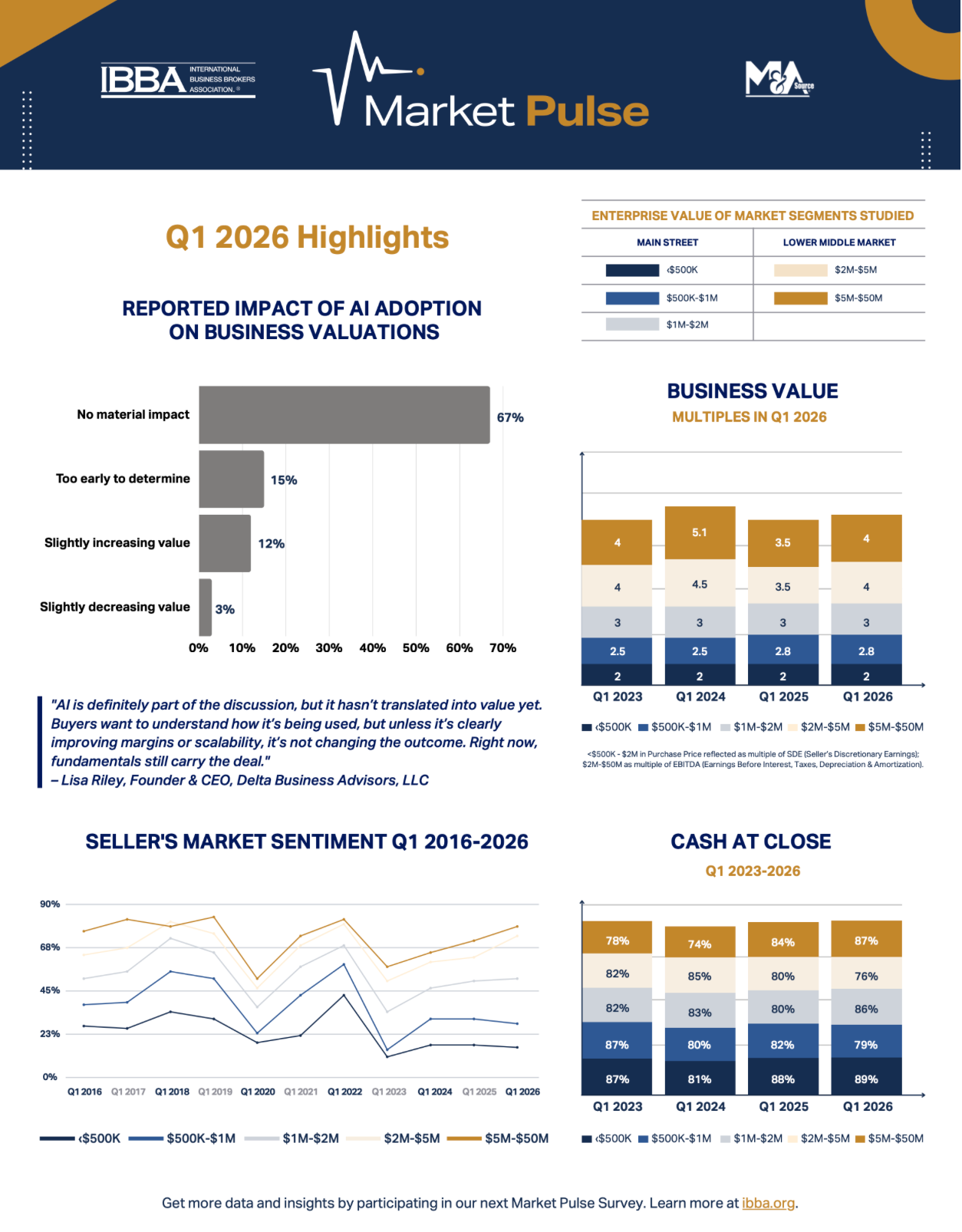
Half. That’s the headline number from the just-released Q1 2026 Market Pulse survey*, the quarterly survey of business brokers and M&A advisors nationwide. This quarter’s report surveyed 300 respondents. Fifty percent of the transactions reported in the quarter by those respondents terminated without closing, up slightly from 48% in Q1 2025. That number is striking on its own. It’s more striking against the rest of the data, which describes a market that is active and functioning. Forty-three percent of advisors reported stronger transaction activity over the last twelve months, against just 21% reporting weaker conditions. Seller confidence is climbing back toward prior peaks, particularly in the lower middle market. Multiples and cash-at-close levels are holding steady. And sellers are receiving between 84% and 98% of their benchmark price for businesses valued up to $5 million, with the strongest performance at the larger end of that range. So the market isn’t the problem. Buyers are showing up, money is moving, and yet one in two deals is dying somewhere between handshake and close. To understand why, it helps to look at who’s at the table and how they’re paying for it. In Q1 2026, the most common buyer for a business valued up to $5 million was a first-time buyer, and their leading motivation was to buy themselves a job. These are people leaving a paycheck to take over a business, and they overwhelmingly depend on financing to reach the closing table. That shows up clearly in how deals got paid for. Across these same segments, cash at close ranged from 76% to 89%, with seller financing making up another 10% to 16% of most deals. Even in the most cash-heavy segment, better than one dollar in ten came from somewhere other than the buyer’s own cash and senior debt. The lesson for sellers starts here. In this market, financing is part of nearly every transaction. If you’re listing your business expecting an all-cash buyer to walk in and write a check, the data says reset that expectation. Once financing is involved, so is a lender, and a lender potentially means increased scrutiny. That’s where the second half of the data is telling because the people walking into that scrutiny are, by and large, walking in for the first time. Eighty-six percent of advisors report that first-time sellers make up at least half of their current engagements, and 60% say first-timers account for three-quarters or more. Most of them arrive unprepared, according to the survey, unfortunately. Across the segments up to $5 million, between 39% and 68% of sellers engaged in no formal planning at all before going to market, and the smaller the business, the more pronounced the gap. As Scott Bushkie of Cornerstone Business Services observed in the report, many owners are navigating one of the most significant financial events of their lives with no prior experience to draw on. When you haven’t done it before, he noted, “you don’t know what you don’t know.” So here is the picture Q1 2026 actually paints: an active market, full of first-time sellers who haven’t prepared, meeting first-time buyers who can’t close without a lender’s approval. That combination is exactly where deals die. The next section walks through a real example of one of them. Source: IBBA & M&A Source Market Pulse Survey, Q1 2026. *If you would like a courtesy copy of the full report, message me here to request a copy.
by Terri Stallworth 10 June 2026
FOR IMMEDIATE RELEASE Terri Stallworth Recognized by the International Business Brokers Association with 2025 Chairman’s Circle Award Jacksonville, FL – June 10, 2026 – Terri Stallworth, Certified Business Intermediary of Florida Business Exchange, Inc. (FBX) has been recognized by the International Business Brokers Association (IBBA) with the prestigious Chairman’s Circle Award for outstanding performance during 2025. The award was presented at the 2026 IBBA Annual Conference held in Minneapolis, Minnesota. The IBBA is the world's largest professional trade association for Business Brokers and M&A Advisors. The Chairman’s Circle Award recognizes business brokerage professionals who have demonstrated exceptional achievement in facilitating successful business transactions and serving business owners throughout the business transfer process. “This award is a great honor because it speaks to the education and training that I have benefitted from over the years through the IBBA, Business Brokers of Florida, and FBX, but more than that, it speaks to all of the business owners, customers, referral partners, and supporters who have put their trust in me to help them with one of the most important transitions of their lives in many cases. I am incredibly grateful for that trust and support because it’s helped me continue to grow and thrive in an industry that often tests your tenacity and resilience,” said Stallworth. Emily Bowler, Executive Director of the IBBA, congratulated this year's award recipients. "The professionals recognized through the IBBA's Member Excellence Awards program represent the highest standards of our profession. Their dedication, expertise, and commitment to helping business owners successfully transition their businesses have a lasting impact on entrepreneurs, employees, families, and communities. We are proud to recognize Terri Stallworth for this outstanding achievement and her contributions to the business brokerage industry." Award recipients are recognized based on verified business transactions completed during the previous calendar year. The IBBA's Member Excellence Awards program celebrates the accomplishments of professionals who demonstrate excellence in business brokerage and mergers and acquisitions advisory services. For more information about Terri Stallworth and Terri Sherman Stallworth, PA or Florida Business Exchange, Inc., visit www.MindYourBusinessToday.com or contact Terri@MindYourBusinessToday.com. About Terri Sherman Stallworth, PA Terri Stallworth has been with Florida Business Exchange, Inc. since 2011 as a Business Intermediary operating under Terri Sherman Stallworth, PA (formerly Terri D. Sherman, PA). She is a member of the Business Brokers of Florida (BBF) and International Business Brokers Association (IBBA), through whom she is designated a Certified Business Intermediary (CBI). She specializes in the sales of main street businesses and has sold a host of businesses across the state of Florida. Terri has been the recipient of the BBF’s “Million Dollar Plus” & “Dealmaker” awards, and the IBBA’s “Outstanding Producer” & “Chairman’s Circle” awards. She is ready to help you “mind your business today”! About Florida Business Exchange, Inc. Florida Business Exchange (FBX) has been serving buyers and sellers in the state of Florida since 1990. Founded by the current Broker/Owner, Bert Risdon, the company was one of the few business brokers in the state and established its first office in the Orlando, Florida area. In the early 2000’s, FBX began to expand and opened offices in Tampa Bay and Jacksonville. In 2016, FBX established a corporate headquarters in Volusia County, Florida and began to actively recruit new associates for the various offices around the state. As of today, FBX is one of the largest non-franchised business brokerage firms in Florida and has sold over 1500 businesses worth over 500 million of dollars. About the International Business Brokers Association (IBBA) Founded in 1984 and with more than 3,000 members worldwide, the International Business Brokers Association (IBBA) is the largest international non-profit association operating exclusively for people and firms engaged in business brokerage and mergers and acquisitions. The IBBA provides education, conferences, professional designations, networking opportunities, and resources to support the business brokerage profession and the successful transfer of business ownership. For more information, visit www.ibba.org . 
by Terri Stallworth 15 May 2026
A lot of sellers are surprised to learn that their business itself has to qualify for an SBA loan, separately from the buyer. SBA 7(a) acquisition financing isn't like a home mortgage, where the bank evaluates the borrower and the property is mostly collateral. The lender is essentially underwriting two borrowers at once: the human buyer (credit, experience, liquidity, post-close working capital) and the business itself (cash flow, add-back legitimacy, industry risk, customer concentration). If either side fails underwriting, the deal doesn't fund. That's why a seller can have a perfectly qualified buyer sitting at the table and still watch the deal fall apart, not because the buyer was the problem, but because the business couldn't carry the proposed debt at the agreed price. Sellers often experience this as "the buyer's loan fell through," when the real issue was on their side of the table. Frequent reasons businesses don't qualify for an SBA 7(a) loan: 1.The business cash flow genuinely doesn’t support the debt at the asking price: This comes down to a metric called the Debt Service Coverage Ratio (DSCR). Lenders want to see the business producing at least 1.25x the debt payments the buyer would take on at closing. 2. Cash flow exists on paper but can't be substantiated: We often call this “owner to prove” financials. Though they may be real numbers that can be proven through bank statements, POS reports, or similar means, if it can't be documented and proven through financial statements and tax returns, it can't be counted from the lender’s perspective. 3. Add-backs are too aggressive: You may have heard some say, “I write everything off through my business!” Well, that may be so. However, not all of those discretionary expenses are valid add-backs from the lender’s view, and the lender won't credit them. So the cashflow is reduced because those “write-offs” stay in the expenses. 4. Something structural about the business is amiss: A heavy customer concentration, deep owner dependence, or a difficult industry are just a few examples of issues that make the lender hesitant regardless of the gross revenue and/or profit. An honest word about add-backs: There's a common belief that lenders are unpredictable and will slash add-backs to ribbons. The truth is closer to the opposite. Lenders are conservative and predictable. When add-backs are recast the way a lender will actually evaluate them—defensibly, not aspirationally—somewhere in the range of 90–95% of them survive review. The breakdowns happen when the recast was inflated to puff up the headline number, not because lenders are out to get anyone. A role of a good business intermediary is to help best position you to successfully get through underwriting, and that often starts with the recast financials. The knowledge gap that surprises most sellers: Buyers often understand DSCR better than sellers do. That may sound backwards… you'd expect the seller, who's run the business for years, to know the cash flow inside and out. Yet, buyers learn this material because they have to. They sit across from an SBA lender and get the education whether they want it or not. Most sellers have never had that conversation. As you begin thinking about a business exit, especially through a sale, ask the business intermediary you’re working with what you need to know about DSCR that you may not know. What this means for you: If selling is on your radar, even if it's a year or two out, running the DSCR math early is one of the most valuable exercises you can do. It tells you whether your asking price is supportable by financing, where your add-back stack might be exposed, and what (if anything) needs to be tightened up before going to market. When the price is right and the numbers hold up, deals close. When they don't, you tend to learn it the hard way, usually after weeks of momentum and one disappointing call from the buyer's lender. Bottom line: clean books, defensible add-backs, and a price that pencils to a real DSCR aren't merely nice-to-haves. They're the foundation every successful sale is built on ! A note about businesses that won’t work for SBA financing: When a business won't qualify for SBA financing at the desired price, or at all, it doesn’t mean the business isn’t viable. It just means it isn’t viable for SBA financing. There are still paths to a deal, most often through seller participation (a seller note covering some of the gap) or through a strategic buyer who isn't relying on third-party financing. These structures aren't a fallback so much as a tool, and they're worth understanding well before they're needed.
by Florida Business Exchange | Proud Sponsor of the 2025 Small Business Success Summit 22 May 2025
Running a small business can feel isolating at times, but you’re not alone. That's why the Florida Business Exchange believes so strongly in the power of connection and community through events like the 2025 Small Business Success Summit . This annual event, hosted by the Florida SBDC Network, is more than just a conference. It’s a space where entrepreneurs come together to learn, connect, and grow. And as a proud sponsor, we want to share why events like this are so valuable to Florida’s business community. Why this matters: Professional development is essential for staying competitive and thriving in today’s fast-changing business environment. Whether it’s learning a new skill, gaining fresh insights, drawing inspiration, or building a network of like-minded individuals, the time you spend on professional growth directly impacts your business’s success. Here’s what you can expect from attending the Small Business Success Summit: ● Connect with like-minded entrepreneurs who share your challenges and ambitions ● Discover new opportunities, partners, and resources that can help you grow ● Exchange insights and best practices with fellow business owners ● Learn from inspiring leaders and industry experts who offer actionable advice ● Build relationships that can lead to mentorship, collaboration, or investment Let’s Connect No small business succeeds in isolation. Building relationships with other business owners, mentors, and experts can inspire new ideas, spark collaboration, and even open new doors. If you’re ready to invest in yourself and your business, we hope you’ll join us.The 2025 Small Business Success Summit will be held August 18-19 in Tampa at the Grand Hyatt Tampa Bay . Learn more about this year’s event and register at https://floridasbdc.org/success_summit/ .